
Finding Ottawa County Residents
Ottawa County does not maintain one public list of every household. The useful records are purpose-built. The property roll ties an owner to a parcel. Recorded deeds document a land transfer. Michigan voter information can establish limited registration facts. Historical directories and newspapers supply dated household clues. Each source has a different custodian, update cycle, and privacy boundary. That matters when a name is common, an address changed, or a tax mailing address belongs to an owner who lives elsewhere.
Begin with the record that matches the question. An address works best in the property portal or GIS viewer. A former household is often better served by a directory, newspaper index, or deed chain. A name connected to a court or vital event needs a date and another identifier before it can be treated as the right person. Renters, children, mail recipients, and protected-address participants do not become public merely because a nearby parcel has an owner record.
- Use the property search to turn a street address into a parcel and an owner name.
- Compare the situs address with the owner mailing address rather than treating them as the same fact.
- Search the Register of Deeds index by parcel or party to add a dated transfer.
- Use the Michigan voter route only for the public registration information it lawfully exposes.
- For an older household, consult local directory and newspaper collections before making a narrow records request.
Ottawa County Records Offices
Two practical centers shape Ottawa County research. Grand Haven is the county seat and hosts the Register of Deeds research library and court offices. West Olive holds the main county administration counters, including the Clerk, Register of Deeds, elections, and GIS functions. The offices below maintain records that can provide a residents-directory lead. For a full address-by-address chain, use the Ottawa County street directory rather than assuming an office search proves everyone at a property.
Ottawa County Register of Deeds
12220 Fillmore Street, Room 146
West Olive, MI 49460
616-994-4510
Ottawa County Property Search
County portal with local-unit data support
West Olive administration area
Treasurer: 616-994-4500
Ottawa County Elections
12220 Fillmore Street, Room 130
West Olive, MI 49460
616-994-4535
Ottawa County Property Roll
The Ottawa County Property Search is the best starting place for a parcel question. It accepts an owner last name, parcel-number segments, or a house number and street name. The portal also exposes active and inactive parcel choices and links to Property Information, Property Summary, Tax Description, Sales History, Split History, and Parcel Report. Local assessing units maintain much of the owner and address data, so a stale or special record may need a local-unit call.
| Ottawa property field | How it narrows a search | Important limit |
|---|---|---|
| Owner last name | Finds parcels tied to a matching owner name | A name match does not prove occupancy. |
| House number and street name | Locates a situs address | Direction and street-type behavior was not captured. |
| Parcel number segments | Connects the parcel to deed and GIS work | Preserve the portal's displayed segments. |
| Active or inactive parcels | Broadens or restricts the parcel set | Review which choice was used before comparing results. |
See the county property-search screen before using its address and parcel controls.
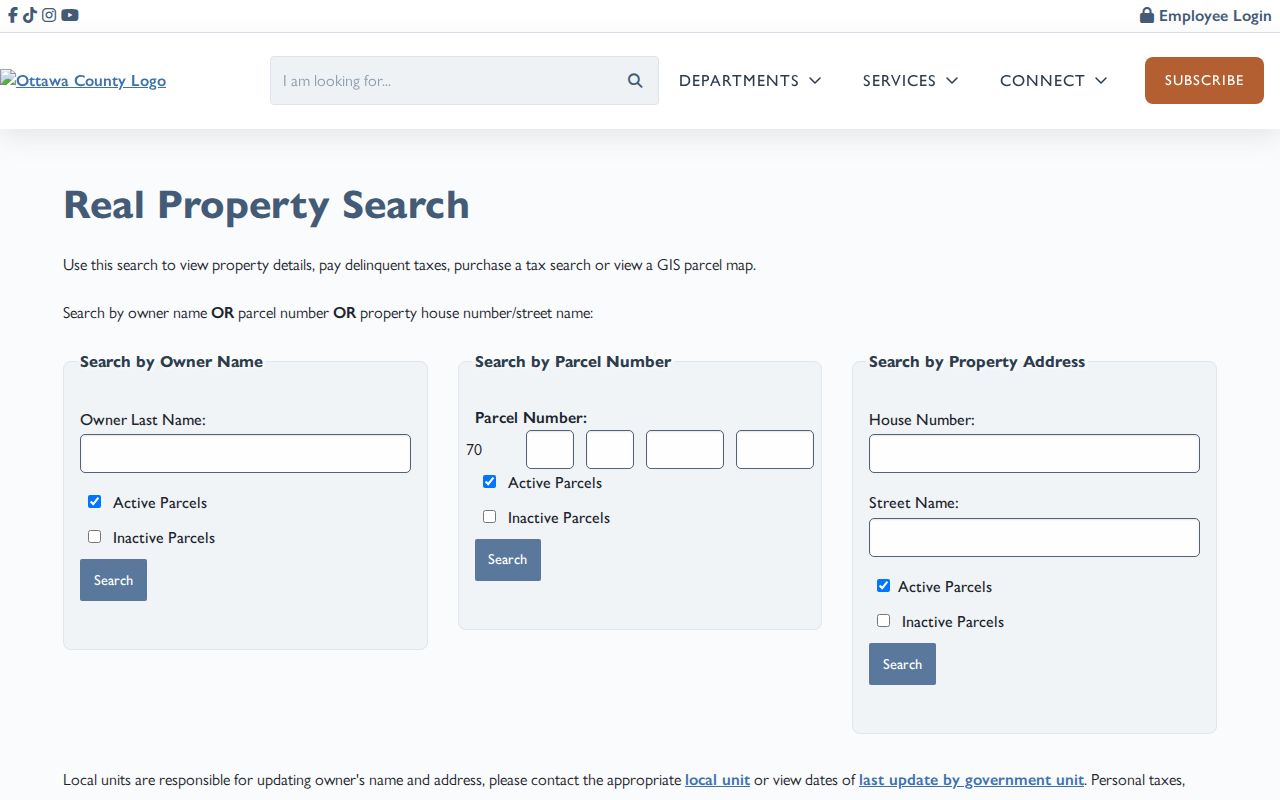
The screen separates owner, parcel, and address work. That separation helps prevent a mailing address from being misread as a home address.
Ottawa County Deed Trail
The Register of Deeds index supplies a dated ownership trail, not a current-household list. Its free search supports a last or business name, date range, document type, liber and page, instrument number, and segmented parcel number. Results are capped at 200. Narrow a broad name with a date or parcel before opening the next step. Online images, printing, and saving can carry a per-page charge and technology fee, while the office lists copies at one dollar per page.
A workable chain starts with the current acquisition document. Record the buyer, seller, recording date, instrument number, and legal description when present. Then search the seller as an earlier buyer. Older documents can identify a lot, block, addition, or legal description instead of the modern street number. The exact beginning year of the online index was not located, so older title work may require the Grand Haven research library, deed books, or the Archives of Michigan. This is a practical reason to keep a parcel number with every address note.
Ottawa County's deed-index search shows the distinct search modes available to the public.
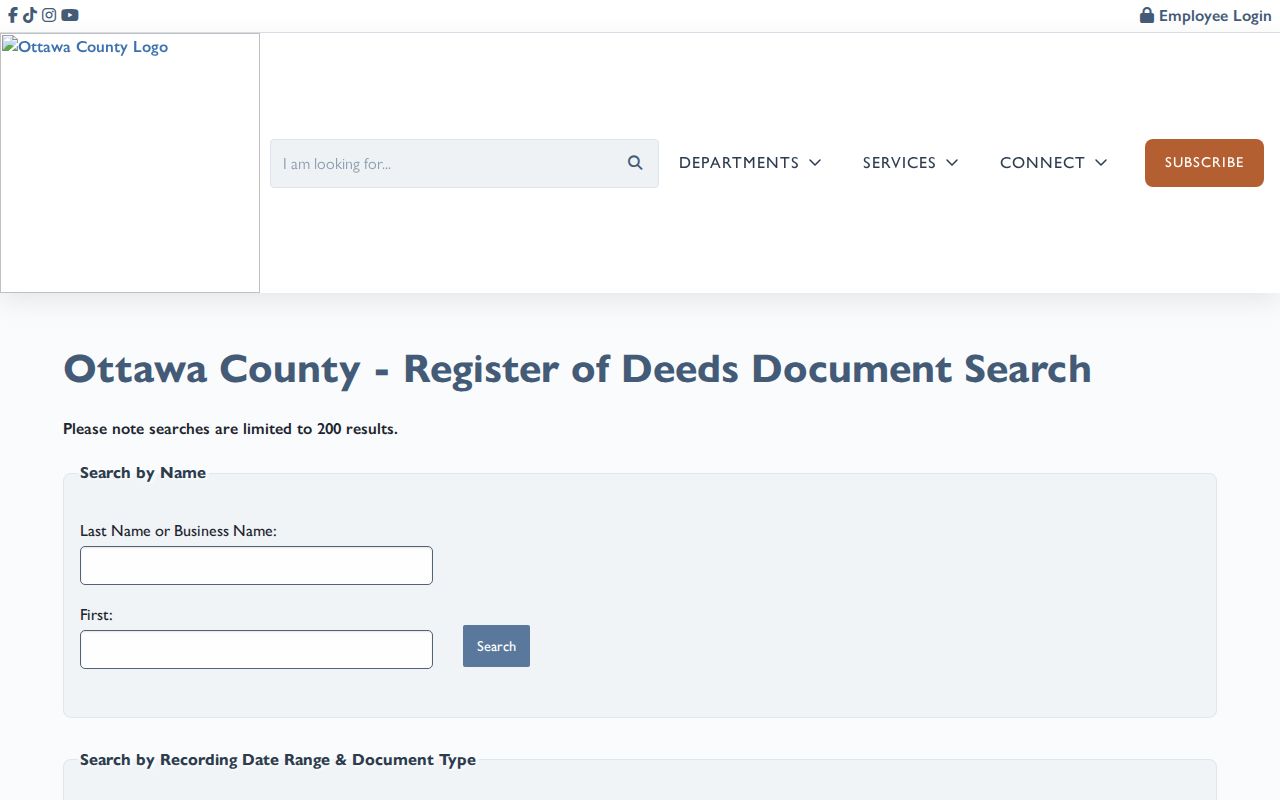
The index can connect people to a recorded document and date. It does not establish who occupied the structure after a transfer.
Note: A no-cost index search can still lead to paid images or copies, so save the instrument details before ordering anything.
Current Ottawa County Resident Rolls
Current directory-like sources overlap, but they do not mean the same thing. A public record can show a registered voter, a parcel owner, a deed party, a court party, or an active prisoner. It rarely provides a complete list of occupants. Use the source with the narrowest factual purpose, then verify the result through an independent record where that matters. The one-person workflow on the Ottawa County resident lookup page uses the same records in a different order.
| Ottawa source | Useful resident-directory clue | Custodian | Access boundary |
|---|---|---|---|
| Property search | Parcel owner, situs, mailing distinction, tax and sale tabs | County and local assessing units | Public display; not occupancy proof. |
| Michigan voter route | Registration, status, precinct, and voter-information lead | Michigan and county elections | Sensitive fields are withheld. |
| Recorded-deed index | Grantor, grantee, document, and land-transfer date | Register of Deeds | Free index; image and copy charges may apply. |
| Local directory collections | Past household and address snapshots | Loutit, Herrick, libraries, archives | Historic material with gaps between years. |
Ottawa County Voter Record Limits
Michigan's Voter Information Center and Ottawa County election services can provide registration and polling information. Registration records are public, but Michigan law does not open every field. MCL 168.509gg protects a driver-license or state-ID number, month and day of birth, phone number, digitized signature, last four Social Security digits, and specified application information. Michigan does not register voters by party, and ballot choices are not public.
The full Qualified Voter File follows a controlled request process with permitted geographic and history choices. It may include names, residence or mailing address where available, year of birth, registration date, status, voter ID, and voter history where available. Delivery and pricing depend on scope. A voter result is registration evidence, not a promise that every person at an address is known or currently present.
Michigan's voter-information entry point is the appropriate public starting point for registration and polling questions.
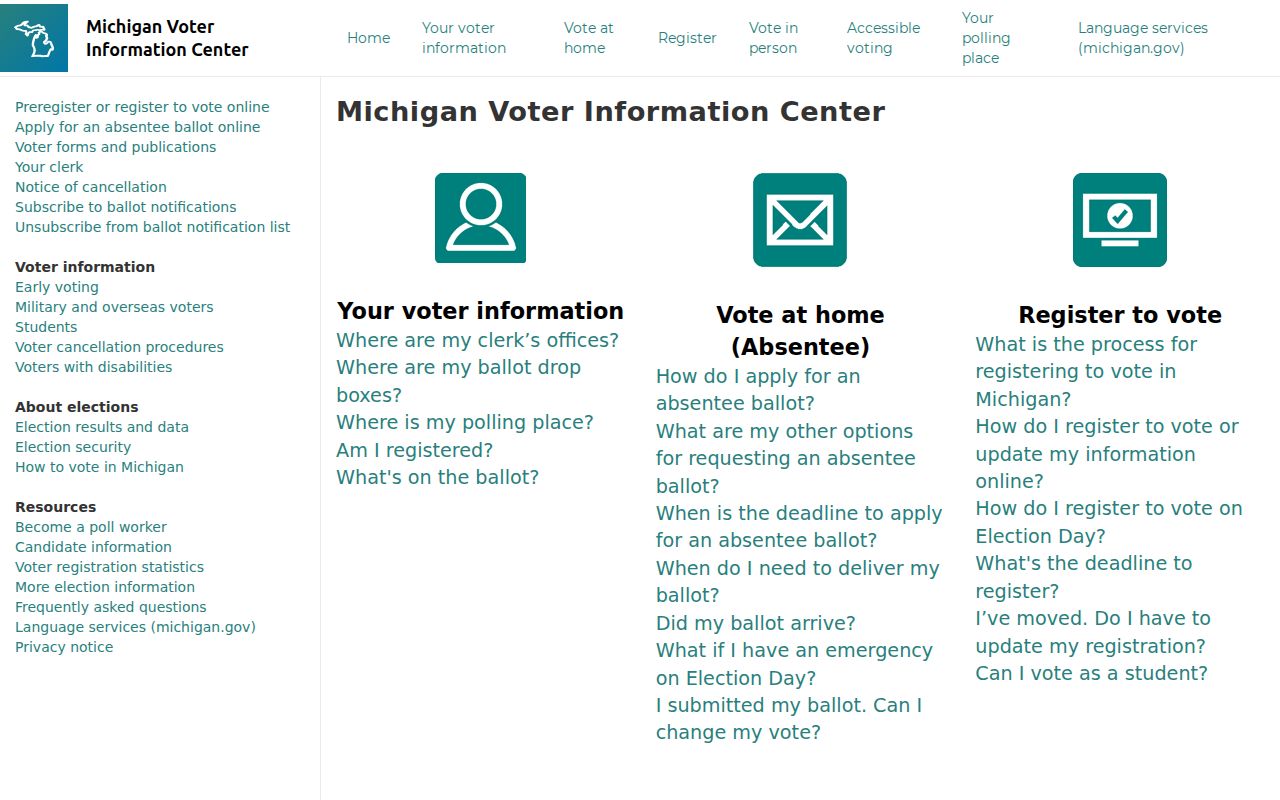
The state interface is a public lookup route, while controlled voter-file requests retain the statutory exclusions for sensitive fields.
Use public facts carefully. Ottawa County records may help with family history, civic research, or a property question. They must never be used to stalk, intimidate, or harm someone, or to bypass a protected address.
Ottawa County Vital Date Bands
The County Clerk has a separate local path for vital records. Ottawa's electronic genealogy resources advertise death records from 1867 and marriage records from 1905, while the order portal displays multiple date bands. Death searches cover 1867 to 1945, 1946 to April 15, 2025, and April 16, 2025 to the present. Marriage choices begin with 1848 to 1912, then use later date bands. A death or marriage index is a lead, not the same thing as a certified record.
Birth access is narrower. Under Michigan's rules, a birth record less than 100 years old is limited to the subject, named parent, legal guardian, legal heir, certain authorized representatives, or a qualifying attorney. Birth records over 100 years are unrestricted. The West Olive self-service terminal has no use charge, and the county also provides online, mail, and in-person routes. The county lists fifteen dollars for the first certified copy and six dollars for an additional copy on the same order, plus any technology fee.
Ottawa County genealogy information explains the local death, marriage, terminal, and mail-search routes.
Ottawa County Court Names
A court index can add a case number, filing date, role, and court, but it cannot be used as a general identity shortcut. Ottawa's 20th Circuit Court, 58th District Court, and Probate Court each have different jurisdiction. MiCOURT is a statewide public information search, not the official court record. It excludes many nonpublic categories and may not display older conviction information in the same way as recent information. A docket result is not a finding of guilt, a complete case file, or evidence of a current address.
The public search pattern includes a court choice, a case-number or case-title concept, and a date range. For an official or more complete file, contact the relevant local clerk with the case number, party name, date range, and whether certification is needed. Probate can be valuable in an estate trail because a filing may identify a fiduciary or heir, but individual documents can be nonpublic. Courts do not provide legal advice.
Review the statewide Michigan MiCOURT case-search interface before treating a name match as a record lead.
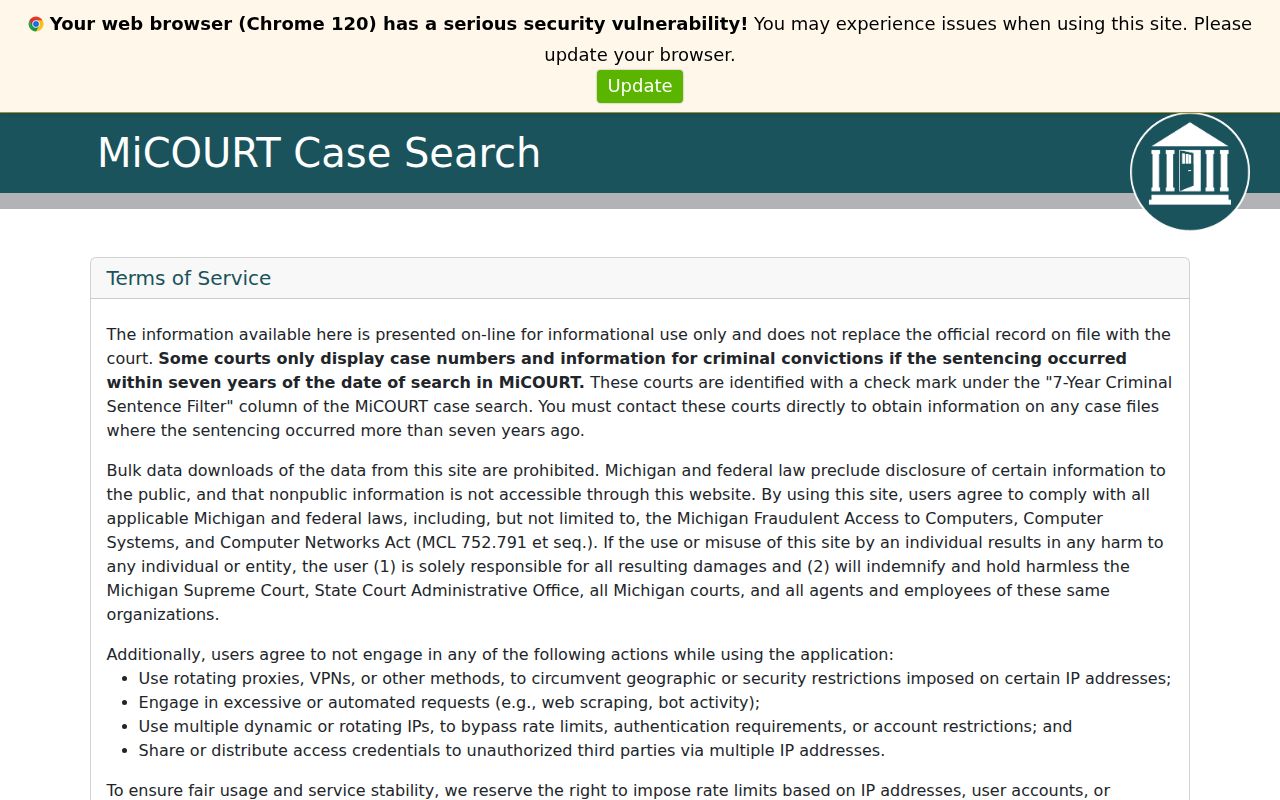
MiCOURT's own disclaimer is important: the search is informational, and the responsible clerk remains the source for the official record.
Ottawa County Records Geography
Ottawa County research has a useful two-center geography. Grand Haven is the county seat, has a courthouse setting, and hosts the Register of Deeds research library at 414 Washington Avenue. West Olive is the main administration location for the Clerk, Register of Deeds, elections, and GIS offices. A postal city name can point elsewhere. Holland, Zeeland, Grand Haven, Spring Lake, and adjacent postal labels do not replace the city, township, or charter-township responsible for a permit, zoning, cemetery, or local clerk record.
The county lists 17 townships or charter townships, six cities, and Spring Lake village. Local units handle much of the building, electrical, plumbing, demolition, occupancy, zoning, and code material. No unified Ottawa municipal permit or cemetery search was located. Start with the county local-contacts map, identify the street's local unit, and ask that custodian for its public record route. This boundary work is especially important when a ZIP code spans city or county lines.
Note: A postal city is a delivery label, while a deed, voter record, or permit is tied to its own jurisdiction and record system.
Historic Ottawa County Directories
Historical residents-directory research belongs in local collections, not just a current portal. Loutit District Library's local-history material identifies a rare 1908 Grand Haven City Directory as the earliest local directory example found in the research. Digitized or cataloged R. L. Polk Grand Haven volumes include 1928 and 1936, with Ferrysburg and Spring Lake context. Herrick District Library adds Holland and Zeeland directory runs, microfilm, local newspapers, genealogy material, and house-history support.
Directory entries can show a name, household connection, historic address, occupation, business, and sometimes a reverse street listing. They are snapshots. A person might be absent because a year is missing, a publisher covered a different area, or a spelling changed. Use directories beside census schedules, deed dates, obituaries, church directories, plat descriptions, and Sanborn maps. The Ottawa County directory book explains the local shelves, scans, and entry-reading method in depth.
Ottawa County Library Trails
When the online record stops, Ottawa's historical institutions supply a second trail. Loutit serves the Grand Haven, Spring Lake, and Ferrysburg area with directories, the Grand Haven Tribune birth, marriage, and obituary indexes, atlases, oral histories, manuscripts, and digital local-history resources. Herrick supports Holland-area work with the Holland Sentinel Microfilm Index, local newspaper runs, cemetery and family histories, and a digital microfilm reader that can email scans. Holland Museum archives are public by appointment and preserve material about area residents, businesses, churches, schools, and organizations.
The Archives of Michigan county guide reaches further back with census, naturalization, military, land, tax, voter, court, and vital record groups. Ottawa land-sales holdings begin in 1858, while federal census materials listed for the county begin in 1870 and state census material includes 1884 and 1894. A failed online search is therefore not proof that no record exists. It may only show that the next source is a shelf, microfilm reel, finding aid, appointment, or a narrow remote request.
- Parcel
- A county identifier for a defined piece of land, used to link property, GIS, and deed records.
- Index
- A finding tool that points to a record. It may not contain the full image or certified copy.
- Criss-cross directory
- A directory arranged by street address, used to work from a location toward historic occupants.
- Roll
- A maintained list for a defined public purpose, such as assessment or voter registration, not a complete household census.
Ottawa County FOIA Boundaries
Michigan's Freedom of Information Act, 1976 PA 442, MCL 15.231 et seq., is the fallback for a county record that is public but not already posted. A request should name the record, date range, address or person, and desired format as narrowly as possible. State guidance gives a public body five business days to respond, with a permitted one-time ten-business-day extension. Authorized fees can cover search, review, separation, copying, and mailing.
FOIA does not open confidential birth details, sealed court material, protected voter fields, Address Confidentiality Program locations, or private DMV data. Ottawa County's portal requires an account for first-time users and links its policies and fee information. Recorded deeds normally use the Register of Deeds index and copy process instead of FOIA. Asking the named custodian for inspection, an ordinary copy, or a certified copy is often clearer than requesting every record connected to a name.
The Ottawa County FOIA portal provides the county's account and request starting point.
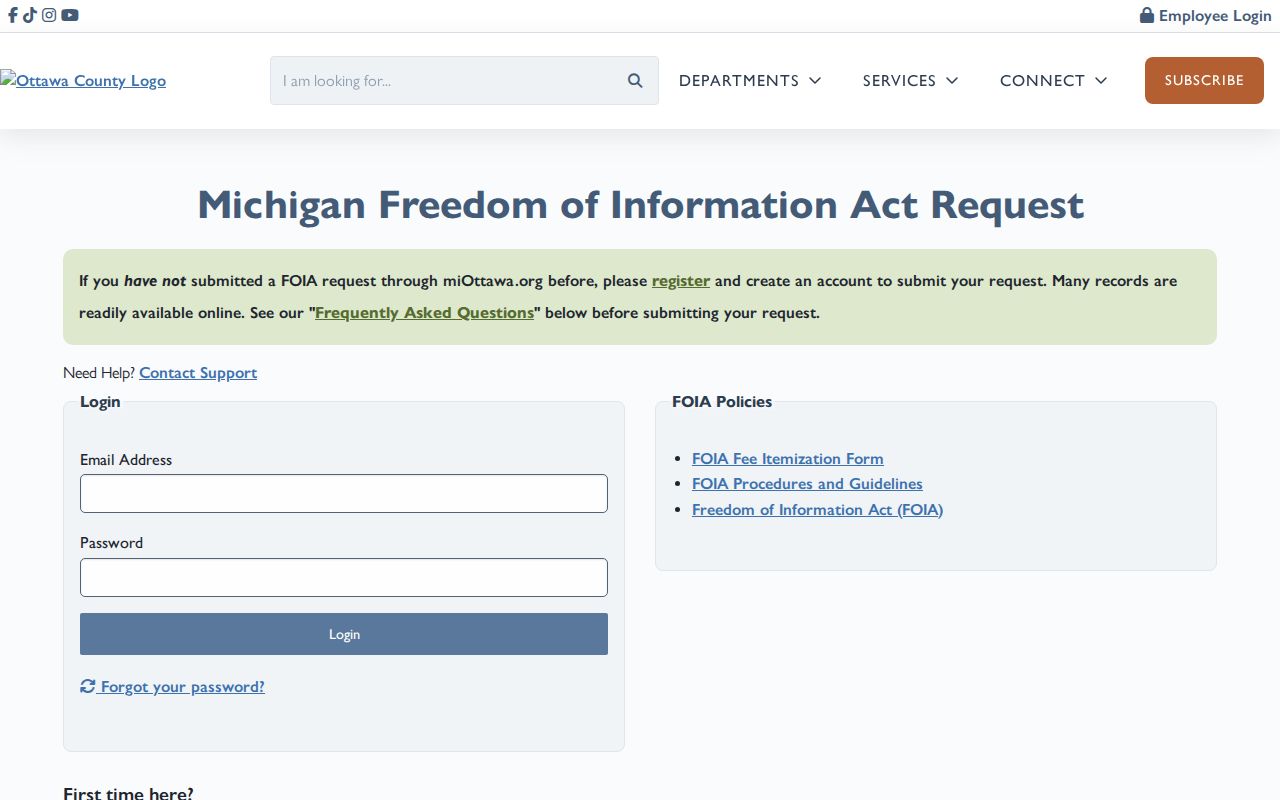
The portal is for a focused public-record request. It is not a substitute for a deed image, protected record, or a broad household search.
Ottawa County Record Safety
Public records sometimes attract scams. Ottawa's Winter 2025 county notice promotes free document-recording alerts through the property-fraud program. Subscribers can receive a phone, text, or email alert when a document is recorded in their name. That service is a notice tool, not proof of a forged deed or a report of who lives in a house. Begin with the official county phone or web address rather than a mailed offer for a costly deed copy.
Michigan's Address Confidentiality Program also sets a firm boundary. Qualifying people at risk of physical harm can use a designated substitute address and mail-forwarding system through an application assistant or advocate. Do not try to reconstruct a protected address through deeds, voter records, maps, or a commercial compilation. Public records are most useful for a narrow family-history, civic, property, or estate question when their limits are respected.