
Ottawa City Directory Collections
Ottawa County’s historic-directory evidence is spread across library rooms, catalogs, digitized books, newspapers, and archives. The documented record begins locally with a rare 1908 Grand Haven example. Later Grand Haven volumes appear in digitized and cataloged form, while Herrick District Library identifies Holland and Zeeland directories from 1984 into the 2000s. A missing year should be treated as a gap in the surviving run, not proof that a household left. The keeper and access method matter as much as the printed year.
| Collection | Years | Where held | Access |
|---|---|---|---|
| Grand Haven printed directories | Earliest local example 1908; 1928 and 1936 digitized or cataloged; complete run not located | Loutit, University of Michigan/Google Books, library catalogs | Local research, catalog, and online copies where available |
| R.L. Polk Grand Haven volumes | 1928 and 1936 documented; regional run from 1928 with complete span unverified | University of Michigan/Google Books and public-library catalogs | Digitized item or library use |
| Holland and Zeeland directories | 1984 through the 2000s highlighted by Herrick; earlier shelf years unverified | Herrick, Library of Michigan, and licensed databases | Library, microfilm, or database route varies |
| Atlases, newspapers, and local archives | Ottawa/Kent atlases from 1849, 1876, 1897, 1912, and 1930; newspaper ranges vary by title | Loutit, Herrick, Hope, Holland Museum, and Archives of Michigan | Onsite, appointment, index, microfilm, or finding aid |
R.L. Polk is the major name-listing publisher discussed by the Library of Michigan, but the state guide also names Bresser, Robinson’s, Norton’s, Johnson Publishing, W.C. Bailey, and Luedder. Those publisher names describe Michigan directory publishing generally. A shelf record or catalog entry must confirm an Ottawa issue before it is used as local evidence.
Loutit’s Ottawa Directory Shelf
Loutit District Library’s genealogy collection serves the Tri-Cities area of Grand Haven, Spring Lake, Ferrysburg, and surrounding communities. Its local-history room lists directories, newspapers, atlases, digital archives, and research services alongside materials such as the Grand Haven Tribune indexes. The room’s posted hours are Monday 9 to 5, Tuesday 2 to 7, Wednesday through Friday 9 to 5, and the first and third Saturday 10 to 2. Fragile local material stays in-house, so bring a pencil and plan to copy citations carefully.
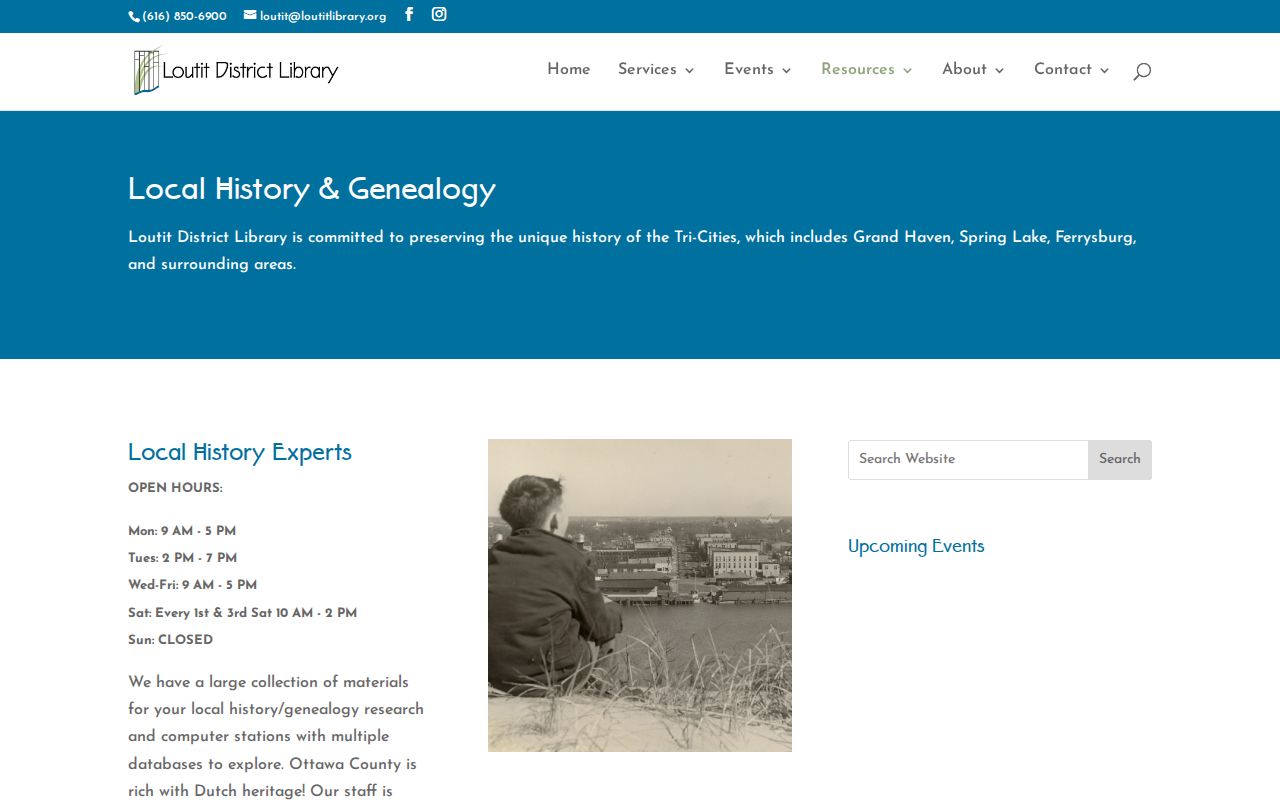
The collection is useful when a historic volume needs companions. Its indexes can lead to obituary, marriage, and birth notices, while its atlases and encyclopedia entries can help place a household on a historic street. Remote research is available by email, mail, or fax, though staff time and postage may create a charge and walk-in researchers receive priority.
Grand Haven City Directory Runs
The earliest locally documented Grand Haven printed-volume lead is 1908. Loutit’s published local-history examples show why that early item deserves careful transcription: Corneil and Alice Addison appear at 413 Lafayette with their children and a dry-goods connection. A later 1929 reference identifies Cornelius as a medical doctor with wife Caroline. The examples are summaries from official local-history material, not a substitute for inspecting the original printed page field by field.
The digitized Grand Haven directory collection documents R.L. Polk volumes for 1928 and 1936. Catalog descriptions extend the regional setting to Ferrysburg and Spring Lake. That scope matters: city-directory boundaries can differ from a modern postal label or municipal line, so record the edition’s place title before deciding that an omission is meaningful.
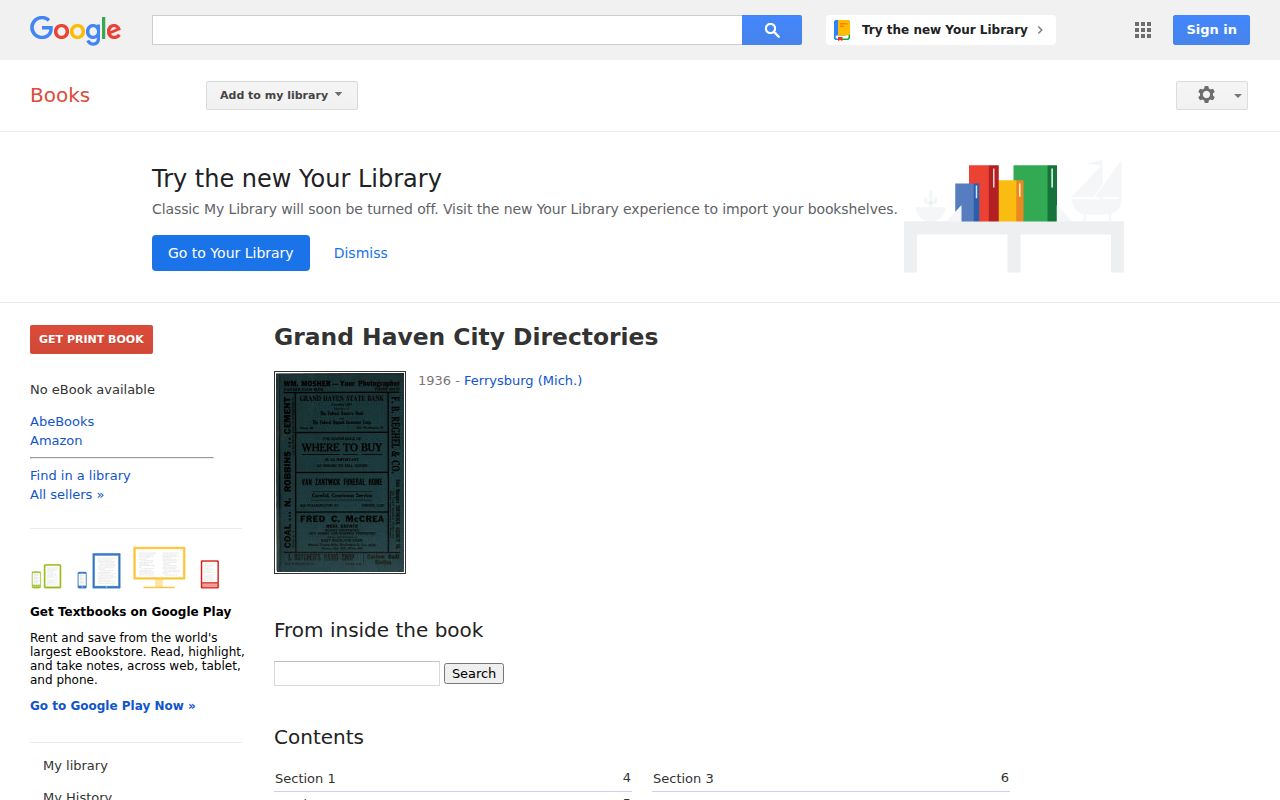
Digitized copies make it easier to check a name against a printed address, but they do not fill every year. Preserve the directory year, publisher, page, exact spelling, and any heading for the city or township. That record makes a later library or archive check repeatable.
Note: A directory’s stated coverage can change between editions, so compare its title page before treating two books as the same geographic series.
Reading an Ottawa City Directory
A historic volume works in two directions when it includes both an alphabetical and a street-order portion. Read the complete line before copying a name. Historic entries can hold initials, a spouse or other household relationship, an occupation or business clue, a number and street, and sometimes an owner or renter mark. The key is edition-specific. Research did not capture an original Ottawa publisher abbreviation key or a verified owner mark, so a symbol should never be guessed from another year.
| Name | Surname, given name or initials, and sometimes a household grouping. Preserve printed variants. |
|---|---|
| Household clues | A spouse in parentheses, children, other adults, or a widow notation may distinguish people with the same name. |
| Occupation or business | A historic job, office, shop, or employer clue can separate similar names and connect a newspaper or business record. |
| Address | A number and street, or an older addition, block, lot, rural route, or local-place reference. |
| Reverse listing | Where present, the street section can return an occupant or business from an address, while the alphabetical list works from name. |
- Criss-cross directory
- The street-order portion of a later directory, used to move from an address to listed occupants or businesses.
- Householder index
- An alphabetical arrangement centered on the household head or named resident, rather than a map or parcel number.
- Abbreviation key
- The volume’s explanation of its shorthand. Photograph or transcribe it before interpreting residence, business, relationship, or ownership marks.
Ottawa Directory Name Variants
Historic spelling needs to stay historic. Loutit’s Clark example calls Chauncey Clark “Chaney” in a historical summary and connects the family from a Pennoyer address to 820 Lake and 634 Lake. His father, Joseph Clark, is identified as a building contractor. That is a strong reason to search a first-name variant, an initial, a spouse, an occupation, and nearby addresses rather than force a modern spelling onto a nineteenth- or twentieth-century record.
The Balgooyen material gives a second test. Fredrika and John Balgooyen appear at 16 S. Sixth with Block 12 Lot 19 in the Munroe & Harris Addition, then can be compared with a 1927 church directory. A lot, block, and addition can bridge a printed volume to a plat and deed even where a street number changes. These volumes offer occupancy clues, while a recorded deed is the title record.
Ottawa Directory Research Rooms
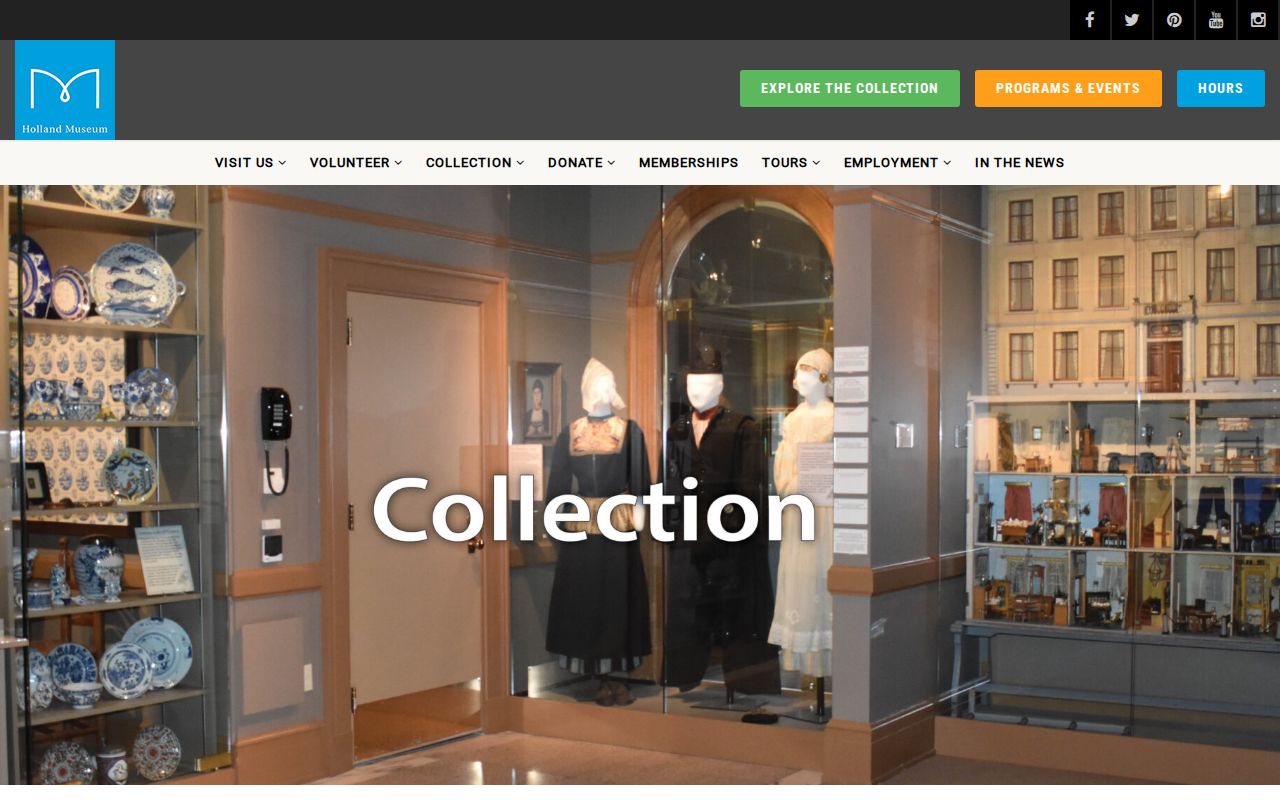
Holland Museum’s archival collection holds more than 100,000 artifacts and archival materials relating to area residents, organizations, businesses, churches, and schools. Access is by appointment. It is especially useful for Holland-area context and address questions that do not fit a published directory. Herrick District Library adds Holland-area genealogy, cemetery and family histories, ship records, the Holland Sentinel Microfilm Index, and public microfilm readers, including a digital reader that can email scans.
The Library of Michigan provides a statewide fallback when the local shelf has a gap. It places alphabetical city and county directories on second-floor south, rare items in the Rare Book Room, and microfilm or fiche in the second-floor south Microfilm Room. Its catalog guidance also points researchers to ANSWER, Ancestry Library Edition, and HeritageQuest routes.
Ottawa record geography has two practical centers. Grand Haven is the county seat and a local-history destination; West Olive is the main county administration location. Holland, Zeeland, Grand Haven, and Spring Lake materials can sit with different custodians, so a historic-volume search should follow the community named in the edition rather than a broad county label alone.
Ottawa City Directory Timeline
Ottawa County was organized in 1837, but its directory trail is much later and uneven. The following milestones describe documented research holdings, not an unbroken publication sequence.
- 1908: The earliest locally documented Grand Haven directory example appears in Loutit local-history research.
- 1928: A Grand Haven R.L. Polk volume is documented in the digitized or cataloged record.
- 1936: Another documented R.L. Polk Grand Haven volume is available through the same digitized collection route.
- 1984 through the 2000s: Herrick’s house-history guidance identifies Holland and Zeeland directory coverage, while earlier full shelf runs remain to be checked.
Directories are only one of several Ottawa historical series. The Archives of Michigan guide identifies land-sale holdings beginning in 1858, county federal census schedules from 1870, and state census listings for 1884 and 1894. Those dates explain why a household search often moves among record groups instead of expecting one annual publication to supply every answer.
Tracing Ottawa City Directory Families
For family history, start with the exact printed address and a street-name variant. Search the reverse or criss-cross section if the edition has one, then check each household surname alphabetically. Record the year, address, spouse or household notation, occupation, and any widow or moved note. Compare neighboring editions rather than assuming there was a volume every year. When a directory and a census disagree, keep both observations and test them against the date each source represents.
- Find the first directory entry for the surname, initials, or address.
- Follow the name forward and backward through the available editions, noting each address and spelling.
- Use the street-order section, when present, to test nearby occupants and businesses.
- Pair the directory snapshot with the relevant federal census or the documented 1884 and 1894 state census records.
- Check deed dates, obituary indexes, newspaper notices, church directories, and plats before concluding that a move or death occurred.
A name disappearing from a historic volume can mean a move, a death, a missing edition, a changed coverage area, or an unlisted household member. Loutit’s Grand Haven Tribune indexes, Herrick’s newspaper microfilm, and Hope College’s index for regional titles from 1872 to 1991 can supply a date to verify in a full notice. When a historical directory clue needs a modern official identity check, use the Ottawa County resident lookup rather than treating an old printed line as current information.
Ottawa Directory Maps and Census
Historic maps make directory addresses easier to interpret. The Library of Congress holds Grand Haven Sanborn sets for 1883 with 18 sheets and 1912 with 24 sheets; both include Spring Lake, Ferrysburg, and Fruitport. A Sanborn map can show a footprint, building use, street arrangement, or alley. It cannot establish who owned or occupied the property. Use it to align a directory address with a deed, plat, newspaper notice, or census record.
For a family connection, the federal census schedules and local directories answer different questions. Census schedules can show a household composition at the time of enumeration. Directories offer a more frequent, though incomplete, city-focused snapshot. Combining them with a legal description, spouse name, occupation, and historical street form is stronger than relying on a single name hit.
Note: Preserve the source, edition, page, and exact transcription so another researcher can revisit the same Ottawa County directory evidence.